

 DeTalks
Learning how to overcome overthinking is less about forcing your mind into silence and more about gently guiding it back to the present. It starts with recognizing thought loops, understanding your triggers, and using practical techniques to shift your focus. Think of it as building resilience and mental clarity, one small step at a time.
Simple strategies like mindfulness, grounding exercises, and structured problem-solving are surprisingly effective places to begin. These tools can help you manage feelings of anxiety and stress, leading to greater overall well-being.
Why We Get Stuck in Overthinking Loops
Have you ever found yourself replaying a short conversation for the tenth time, or spiraling into "what-if" scenarios? If so, you know how draining overthinking can be. This isn't a personal flaw; it's a common human response to uncertainty and pressure.
This pattern, often called rumination, can feel productive, as if you are carefully solving a problem. In reality, it often leads to mental paralysis, trapping you in a cycle of worry that saps your energy and peace.
Understanding the Triggers Behind Overthinking
Overthinking is usually a reaction to specific situations or underlying emotions. For many people, workplace stress is a significant catalyst. The fear of making a mistake or facing criticism can easily send the mind into overdrive.
At its core, overthinking is often driven by a need for control when we feel anxious or uncertain. While it might feel like you're preparing for every outcome, this pattern often amplifies anxiety, and can contribute to feelings of depression over time.
This infographic shows how effective certain practices can be at breaking the cycle.
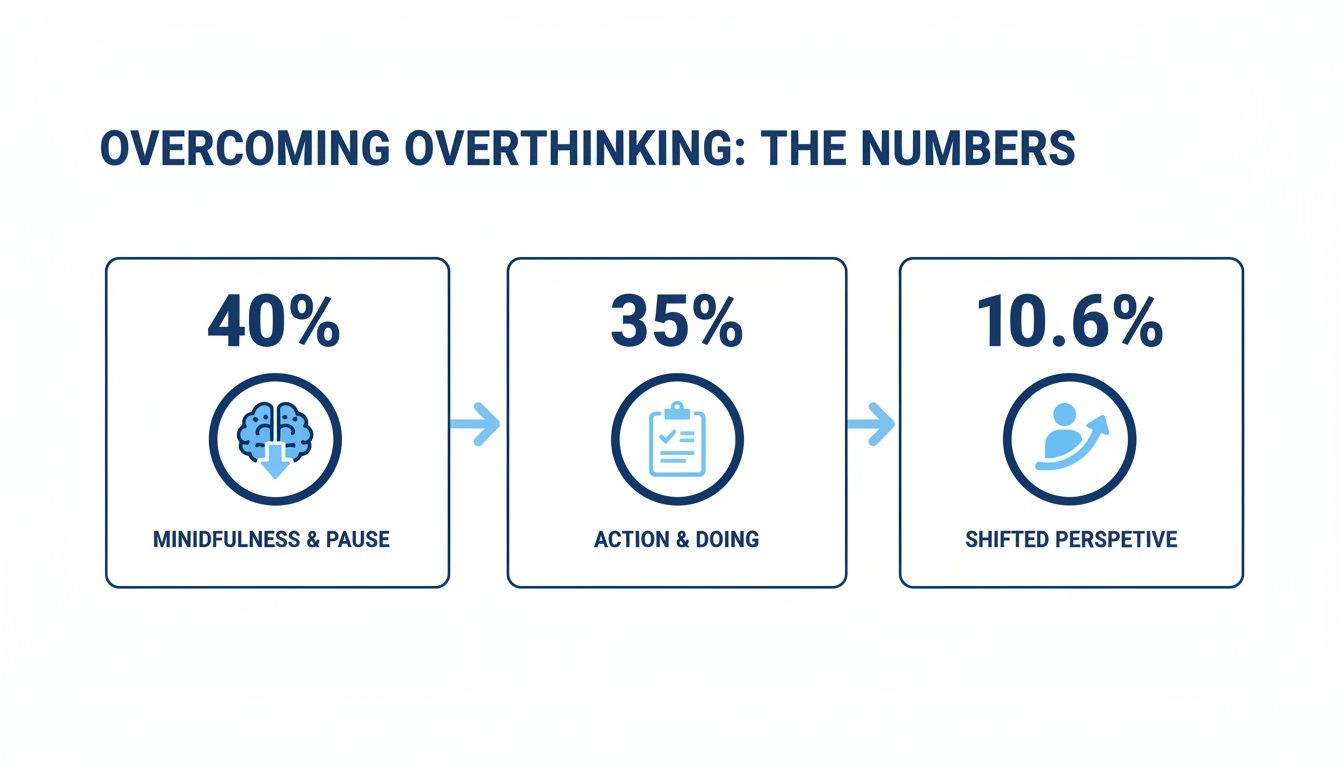
The data speaks for itself—structured mental health techniques can bring measurable relief from the challenges tied to overthinking.
The Impact on Your Well Being
Overthinking is more than a minor annoyance; it has a real impact on your overall well-being. That constant mental chatter can lead to heightened stress, chronic fatigue, and trouble concentrating. Left unchecked, this strain can contribute to burnout, making it hard to connect with your work, relationships, and joys.
Realizing that you’re not alone and understanding the roots of overthinking is the first step toward compassion for yourself. When you see it as a common mental pattern, you can begin to detach from self-blame and rebuild your emotional balance.
In India, this is a particularly widespread issue. The National Mental Health Survey found that a significant portion of the population experiences mental health challenges, where overthinking often shows up as a key symptom of anxiety and stress. The good news is that practical strategies deliver real results. You can explore the full findings to get a clearer picture of mental health trends in India.
When your mind gets stuck, telling yourself to "just stop thinking" is often frustrating and ineffective. What you really need are practical tools to gently redirect your attention and soothe your nervous system. These techniques act as a "pattern interrupt," giving you breathing room to step out of the thought spiral.
The idea isn't to fight your thoughts, but to simply shift your focus, like changing the channel on a TV. Here are three effective strategies you can use anywhere, anytime, to get back in the driver's seat.

Use the Five Senses Grounding Exercise
Grounding is a powerful way to pull yourself back into the present moment. It anchors you in your physical reality, away from the chaos spinning in your head. The Five Senses exercise is a classic because it's simple, discreet, and works wonders when you feel overwhelmed by workplace stress or personal worries.
Just take a slow, deep breath and gently guide your attention to:
- Five things you can see: Really look around you and notice details—the way light hits your keyboard or the color of a plant.
- Four things you can touch: Focus on physical sensations, like the texture of your clothes or the cool surface of your desk.
- Three things you can hear: Tune into the sounds around you, like the hum of a fan or distant traffic.
- Two things you can smell: Take a gentle sniff. Maybe it's the faint scent of coffee or the soap on your hands.
- One thing you can taste: What can you taste right now? Perhaps it’s the lingering flavor of your last meal or a sip of water.
By guiding your brain to process real-time sensory data, you gently redirect your focus away from anxious thoughts.
Practise Structured Box Breathing
When we're caught in overthinking, our breathing often becomes shallow and quick, signaling stress to our brain. Box breathing is a fantastic technique to deliberately regulate that response and bring back a sense of calm. It's a simple and effective way to manage the physical feelings of anxiety.
Visualize a box and follow these steps:
- Breathe in slowly through your nose for a count of four.
- Hold your breath at the top for a count of four.
- Exhale slowly and completely through your mouth for a count of four.
- Hold your breath at the bottom for a count of four.
Just a few cycles of this rhythmic breathing can work wonders. It helps soothe your nervous system, slow your heart rate, and quiet the physical symptoms of anxiety.
Create a Physical Pattern Interrupt
Sometimes, the quickest way to break a mental rut is to shift your physical state. A physical pattern interrupt is any simple, deliberate action that jolts you out of your current state and helps your brain shift gears. This can be a very direct way to improve your well-being in the moment.
Overthinking can remove us from active participation in our lives. Shifting your physical state can be one of the quickest ways back to the present moment and a great step toward building resilience.
For instance, if you find yourself spiraling while at your desk, try one of these:
- Stand up and do a big, full-body stretch.
- Walk to the kitchen and pour a glass of cold water.
- Splash some cool water on your face and wrists.
- Put on an upbeat song and move for a minute.
These actions demand your brain's attention, effectively pulling mental resources away from a looping thought. When a thought spiral takes hold, it can feel impossible to break free, and learning practical techniques like how to stop overthinking at night can be very helpful.
To help you remember these in the moment, here’s a quick summary table.
Quick Relief Techniques for Overthinking Moments
| Technique | How It Helps | When to Use |
|---|---|---|
| Five Senses Exercise | Anchors you in the present by focusing on sensory input, redirecting your attention from anxious thoughts. | When you feel detached or overwhelmed, especially in public or at work. |
| Box Breathing | Regulates your nervous system by controlling your breath, slowing your heart rate and reducing feelings of panic. | When you notice physical symptoms of anxiety, like a racing heart or shallow breathing. |
| Physical Interrupt | Breaks the mental loop by forcing a change in your physical state and redirecting your brain's focus. | When you're stuck in one spot, ruminating, and need a quick jolt back to reality. |
Having these strategies ready means you're prepared to support yourself the next time your mind starts to run away.
Build Daily Habits for Lasting Mental Clarity
Stopping a thought spiral in the moment is a win, but lasting change comes from building new mental habits. Think of it as training a muscle; the more you work on strengthening your mind, the more resilience you build. Let's walk through two powerful daily routines that can help you cultivate long-term well-being.
The goal isn’t to silence your mind completely, but to change your relationship with your thoughts. By giving your worries a specific time and place, you stop them from taking over your entire day. This proactive approach helps turn down the constant background noise of anxiety.

Contain Your Worries with Scheduled Worry Time
One effective way to manage overthinking is to give it boundaries. Scheduled Worry Time is a technique where you set aside a short window—say, 15 minutes each evening—to intentionally think through what’s bothering you. During this time, you have full permission to worry.
The trick is to keep it contained within that specific time. If an anxious thought pops into your head during the day, you can acknowledge it and tell yourself, "I'll think about that during my worry time," then shift your focus.
This simple act does two important things:
- It validates your concerns by giving them a designated space.
- It breaks the rumination cycle by training your brain that there is a time and place for worrying.
This is especially helpful for managing workplace stress, as it can stop you from replaying a single comment from a meeting all day long.
Externalise Your Thoughts with Mindful Journaling
Another powerful habit is journaling, sometimes called a "thought dump." The goal is not to write a perfect entry, but simply to get swirling, repetitive thoughts out of your head and onto paper. This process of externalizing your thoughts can make them feel much more manageable.
Just grab a notebook and spend 10-15 minutes writing down everything on your mind, without judgment. It's like clearing out a cluttered room—once everything is out in the open, it's easier to see what you're actually dealing with.
This practice is particularly helpful in the Indian context, where finding accessible tools for mental health is important for managing stress and anxiety.
When thoughts are trapped inside your head, they can feel overwhelming. The moment you write them down, they become more concrete and observable. This shift in perspective is often the first step toward finding a way forward.
If you're staring at a blank page, try these prompts:
- What’s one thought that has been on a loop in my mind today?
- What’s the worst-case scenario I'm picturing? How likely is it to happen?
- What is one small thing I can actually control in this situation?
- If my best friend came to me with this worry, what would I tell them?
These questions gently nudge you from anxious rumination toward constructive reflection. Combining this with professional counselling or therapy can enhance your progress by providing a structured space to process what you uncover.
Connecting Mind and Body Through Movement and Mindfulness
Have you noticed how your mind and body are connected? When your thoughts are racing, it’s almost impossible to feel physically relaxed. The good news is that this connection works both ways.
One of the best ways to quiet a frantic mind is to shift your focus to your body. Think of movement and mindfulness as a natural reset button for a nervous system in overdrive.
Get Moving, No Gym Required
You don't need a gym membership or an exhausting workout plan to see a real difference. The trick is to find something you enjoy and can fit into your day. Even short bursts of activity can break the cycle of overthinking and improve your well-being.
Here are a few ideas:
- Take a 15-Minute Walk: Step outside for a quick walk and pay attention to the rhythm of your feet and the sounds around you.
- Try Some Simple Stretches: A few gentle stretches can release the tension that builds up when you're stressed.
- Have a Spontaneous Dance Party: Put on your favorite upbeat song and just move. It's about shaking off pent-up energy in a joyful way.
Physical activity is a crucial tool for managing feelings of depression and anxiety. In India and globally, even moderate daily exercise is shown to significantly reduce overthinking symptoms and contribute to building resilience.
Practise a Little Mindful Observation
Beyond movement, mindfulness offers another powerful way to quiet an overactive mind. Mindfulness is the practice of paying attention to the present moment without judgment. It teaches you to observe your thoughts as they arise, rather than getting tangled in them.
Think of your thoughts like clouds drifting across the sky. You can notice them—their shape and speed—without becoming the cloud. This simple act of detached observation is where you can find peace and happiness.
This creates space between you and your thoughts, allowing you to see them as temporary mental events, not undeniable facts. This is a fundamental skill for building resilience.
A Simple Mindfulness Exercise to Try Right Now
You can do this anywhere, anytime you feel your thoughts starting to spiral.
- Get comfortable, sitting or standing, and soften your gaze.
- Turn your attention to your breath. Notice the feeling of air coming in and out.
- Acknowledge thoughts as they arrive. When a thought pops up, mentally label it "thinking" without judgment.
- Gently guide your focus back to your breath. Each time your mind wanders, patiently bring your attention back.
The point isn't to stop your thoughts, but to change your relationship with them. This mind-body connection is a cornerstone of effective counselling and therapy for managing everything from workplace stress to anxiety.
How to Challenge and Reframe Your Anxious Thoughts

One of the most powerful realizations you can have is that your thoughts are not facts. They are stories your brain tells itself, often shaped by past fears and future worries. Learning to gently question these stories is a core skill in building resilience against anxiety.
This isn't about arguing with yourself or forcing positivity. It's about becoming a curious observer of your own mind and separating what’s happening from the narrative around it.
First, Catch the Thought
You can’t challenge a thought you don't realize you're having. The first step is to simply notice when a repetitive, unhelpful thought takes hold. It requires a bit of mindfulness to catch the thought before it spirals.
Imagine you made a small mistake at work, and your mind jumps to, "Everyone thinks I'm incompetent." That specific thought is the one you need to catch. A cornerstone of cultivating a calmer mind is learning how to let go of negative thoughts.
Your initial anxious thought is often an emotional reaction, not a logical conclusion. Learning to pause and identify it is the first step toward reclaiming your power over it and finding more happiness.
This practice helps you see the thought as a separate entity. It transforms the feeling from "I am a failure" to "I am having the thought that I am a failure," creating mental space for the next step.
Next, Check the Evidence
Once you've identified the thought, it’s time to examine it objectively. Ask yourself a few simple, clarifying questions to test whether it holds up. This isn't about proving the thought wrong; it's about finding a more balanced perspective.
Questions to Ask Yourself:
- What is the evidence that supports this thought? Be honest.
- What is the evidence that contradicts this thought? Think about past successes or positive feedback.
- Is there a less extreme, more balanced way to look at this?
- What would I tell a friend in this exact situation? We often offer more compassion and perspective to others.
This gentle questioning helps you see that your initial thought was likely an exaggeration, a product of anxiety rather than reality.
Finally, Change the Narrative
The last step is to consciously create a new, more balanced and compassionate thought. This isn't about empty affirmations, but about crafting a statement that is realistic and supportive. Based on your evidence-checking, you can build a new narrative.
Here’s how that looks in practice:
- Original Thought: "I'm going to get fired for this mistake."
- Reframed Thought: "I made an error, which feels uncomfortable, but it's a learning opportunity. My overall performance is strong, and I can fix this."
- Original Thought: "Everyone at the party thought I was so awkward."
- Reframed Thought: "I felt a bit awkward, but it’s unlikely anyone was focused on me that much. I had a nice conversation, and that’s a good start."
Practicing this three-part process—Catch, Check, and Change—trains your brain to find a more balanced perspective over time. It forms the bedrock of lasting mental well-being and helps you navigate stress, depression, and anxiety with greater ease.
When to Seek Professional Support for Your Well Being
The self-help strategies we’ve covered are fantastic tools, but knowing when to bring in a professional is a true sign of strength. It’s an act of self-compassion to recognize that you don’t have to untangle persistent mental loops all on your own. Seeking support is a proactive step toward reclaiming your mental space and building lasting resilience.
Sometimes, no matter how hard you try, overthinking can feel like a heavy blanket you just can't shake off. If your thought patterns are causing real distress or getting in the way of your daily life, it’s a good time to talk to a professional.
Recognising the Signs You Might Need More Support
It’s not always obvious when self-help isn’t enough. In India and around the world, it can be tough to know when to reach out. But there are a few clear signs that professional guidance could make a huge difference.
If any of the following feel familiar, thinking about therapy or counselling is a great next step:
- You're constantly anxious or sad, and the feelings don't lift.
- Your daily life is suffering, affecting your work, relationships, or hobbies.
- You feel completely stuck, even after trying different techniques.
- You’re using unhealthy coping habits to quiet your mind.
If these points resonate, please know that help is out there. A professional can offer a safe space to explore what’s driving the overthinking, which is important for tackling issues like workplace stress, anxiety, and depression.
How DeTalks Can Guide Your Next Steps
Finding the right mental health support can feel overwhelming, which is why platforms like DeTalks exist. We offer confidential, science-backed assessments that can give you a clearer picture of your emotional state. Please remember, these assessments are informational tools, not a diagnosis, but they can be a helpful starting point.
Seeking support isn't about admitting defeat; it's about equipping yourself with the right tools to build a healthier, more balanced life. It’s a courageous investment in your long-term well-being and happiness.
Armed with these insights, you can connect with qualified therapists and counsellors on DeTalks who specialize in managing anxiety, building resilience, or navigating stress. Taking that step is a powerful way to go from feeling stuck to feeling empowered.
Common Questions About Overthinking
It’s natural to have questions when you’re trying to understand the constant chatter in your head. Let's clear up a few common points that come up on the journey to a calmer mind and improved well-being.
Is Overthinking the Same as Anxiety?
No, but they are closely related. Overthinking is the mental habit—the endless loop of worrying. This habit often fuels anxiety, which is the emotional and physical feeling of unease. Learning how to overcome overthinking is a powerful way to manage feelings of anxiety.
Can I Stop Overthinking Completely?
The goal isn't a completely silent mind, but rather to change your relationship with your thoughts. The techniques we've covered help you spot thought loops, step back from them, and gently guide your attention elsewhere. It's less about eliminating thoughts and more about reducing their power over how you feel.
Your thoughts are like clouds passing in the sky; you can learn to observe them without becoming the storm. The aim is to build resilience so that your thoughts no longer control your emotional state and you can experience more compassion for yourself.
How Do I Know if I Need Counselling?
If overthinking is significantly impacting your daily life—your sleep, work, or relationships—it's a good time to consider professional support. When self-help strategies aren't enough, reaching out to a therapist is a sign of strength. Therapy can provide a personalized roadmap for understanding these thought patterns.
Professional counselling offers structured support that can make a real difference for ongoing challenges like workplace stress or symptoms of depression. It provides a safe space to build coping skills that will last a lifetime.
Ready to take a meaningful step toward a quieter mind? The professional therapists at DeTalks are here to help guide you. You can explore our confidential, evidence-based assessments and get connected with the right expert for you.
Visit the DeTalks website to get started.